Wednesday, 21 August 2019

Grace O'Malley and her DNA

One of the great aspects of Ireland’s heritage is the fact that we have the oldest genealogies in Europe. [1] These relate to the ancient Irish clans (septs) and their colourful chieftains, kings and queens.

Not all of these genealogies are 100% accurate – some times they were modified for political reasons or social climbing – but with the advent of genetic genealogy, the exciting possibility has emerged that the truth or otherwise of these ancient genealogies can be confirmed through Y-DNA testing. And a direct offshoot of this is the possibility to link your DNA with that of famous Irish medieval royalty, such as Brian Boru, or our very own Grace O’Malley, the Pirate Queen (1530-1603). The link to Brian Boru is well-established. But the question is: can we do something similar for Grace and the wider O'Malley clan?

Grace O’Malley meeting Queen Elizabeth I in 1593

Let's look at the case of Brian Boru and see what lessons it can teach us.

Identifying the DNA Signature of the Dal gCais

Brian Boru was first High King of Ireland and was famously killed at the Battle of Clontarf in 1014.  The Ancient Annals are historical texts that recorded the genealogies of many Irish tribes/clans. They tell us that Brian Boru belonged to the clan of the Dal gCais (pronounced Doll Gosh) which was a tribe/sept that descended from a man called Cas (born 347 AD) whose 5x times great grandfather was Oilioll Olum, King of Munster (and therefore born about 150 AD). This sept rose to prominence in the south of Ireland and was centred around Clare, Limerick & northern Tipperary. As the clan evolved over time, it gave rise to many distinct branches each with their own surname. These Dalcassian surnames included: O'Brien, Casey, McGrath, Hogan, and many more. But they all had the same root - the clan of the Dal gCais. And therefore (if the Annals are true) they should all share a similar genetic signature.

Fast forward to 2006 and Ken Nordtvedt, an intrepid genetic genealogist, notices that a particular Y-DNA signature seems to be emerging for people with ancestry in southwest Ireland. Y-DNA is most informative for this research as (like the surname) it follows the direct male line. Another genetic genealogist, Dennis Wright, then decides to investigate this further. Dennis runs the R-L226 (Irish Type III) DNA Project and is co-administrator of the O’Brien DNA project. [2,3]

Dennis took the Irish Type III signature and searched the available databases for people with this Y-DNA signature. He identified 191 people with this signature and subjected them to further analysis. You can read his paper detailing the analysis here. [4] Most of the sample had Irish surnames, supporting an Irish origin for this particular genetic signature. Of those that had genealogical information available, most had MDKAs (Most Distant Known Ancestors) that had origins in the area around Clare, Tipperary & Limerick (the ancestral homeland of the Dal gCais).

He then assessed the ancient genealogy of the Dal gCais (from O’Hart’s version, which is readily available online) to identify modern-day surnames that supposedly arose from the Dal gCais (so-called Dalcassian surnames). [5] He then asked two very specific questions:
  1. what proportion of people with the DNA signature have Dalcassian surnames?
  2. what proportion of people with Dalcassian surnames have the signature?


Dalcassian surnames identified by Dennis & placed in a "family tree"

How many with the Signature have the Surname?
Dennis found that a significant proportion (29%) of the 191 men with the DNA signature had Dalcassian surnames. Conversely, 71% of the sample did not have Dalcassian surnames. A certain discordance is to be expected due to the occurrence of Surname or DNA Switches (SDS, aka NPEs) over the course of time. People often cite adoption & illegitimacy as obvious examples of how Y-DNA can be switched or become dis-associated with a particular surname, but there are many other causes including switching one’s surname to that of the Clan Chief as a sign of allegiance to him – a custom practiced throughout the time of the Irish clans. [6] Dennis cites a perfect example of another frequently overlooked cause. Morgan O’Brien married Eleanor Butler in 1690 and changed his surname to Butler, probably to ensure his and his wife’s right to inherit Butler lands near Bansha in Co. Tipperary. Thus any sons born to the couple would have carried the Butler name but O’Brien Y-DNA. [4]

How many with the Surname have the Signature?
Dennis also explored the potential association from the other way around – what proportion of people with the surname have the signature? He again searched the available databases to see what proportion of the surnames identified in his original sample (191) were associated with the DNA signature. Of 271 people with Dalcassian surnames, 57 had the signature (21%). And of 371 men with non-Dalcassian surnames, only 37 had the signature (10%). This difference (21% vs 10%) is statistically significant, further supporting the association of the specific DNA signature with the Dal gCais.

Subsequently, a direct male line descendant of Brian Boru took the Y-DNA test. He has a 30-generation pedigree that goes all the way back to Brian Boru. [7] The results came back revealing that he too shares the Irish Type III signature.

Dennis carried out this work in 2009, using only STR markers. Since then, the Irish Type III signature has become associated with a specific SNP marker (L226+) and a huge body of additional evidence has accumulated that bolsters the conclusions of the original study.

Brian Boru would have tested positive
for the SNP marker L226 (had he lived)

This was one of the earliest examples of how the Y-DNA signature of specific clans (and even specific leaders) could be determined through genetic genealogy. And the same basic methodology applies to any similar research being conducted today, and can equally be applied to help determine the Y-DNA signature of the O'Malley clan of Burrisk, Co. Mayo, which gave rise to Grace O'Malley, the Pirate Queen (1530-1603).

So to summarise the methodology developed by Dennis, the genetic signature of any specific clan can potentially be identified by demonstrating that:
1. Men who carry the specific Y-DNA signature have a higher frequency of MDKA origins in the ancestral clan territory (again, only men have Y-DNA, and this follows the direct male line along with the surname)
2. There is a significant preponderance of the specific DNA signature among men with clan-associated surnames
3. There is a significant surplus of clan-associated surnames bearing that specific DNA signature
4. People with an established genealogy going back to the specific clan also share the same specific Y-DNA signature

Identifying the DNA signature of the Mayo O'Malley's

Currently the O’Malley DNA Project has over 140 members and 70+ Y-DNA samples. [8] Of the 5 genetic groups within the O’Malley DNA Project, one has strong connections with Mayo, the ancestral county of Grace's clan. The Y-DNA signature of this group (Group 3) is therefore a prime candidate for the signature of the Mayo O'Malley clan. However, this group is subdivided into several subgroups - this complicates the analysis as any one of them could represent the signature of the clan. A further complication is the high risk of "chance matches" due to Convergence - a known issue with those people who sit on the M222 branch of the Tree of Mankind.


As a first step, we would need to clarify Grace's direct male line pedigree (back beyond the origins of the O'Malley clan) and put together a list of surnames supposedly associated with it over the passage of time (say, from about 200 AD onwards). This information can be gleaned from online sources, supplemented by data from The Great Book of Irish Genealogies (Leabhar Mór na nGenealach) by Duald Mac Firbis (written in 1650, published in 2004). [5,9]

The genealogy of the direct descendants of Grace is documented in the authoritative biography of Grace O'Malley by Anne Chambers, who runs the Grace O'Malley website. [10] Some lines of descent may extend to the present day. However, the Y-DNA in these situations would belong to Grace's husbands (Donal O'Flaherty & Richard Burke) ... and we could certainly try to identify this but it is not O'Malley Y-DNA. This is because Y-DNA is only passed from father to son ... and Grace (being a woman) would not have had a Y chromosome to pass on to her offspring. She would have passed on autosomal DNA to her children and this would have been chopped up, roughly halved, and passed on to the offspring of each subsequent generation up to the present day. As a result, modern day descendants of Grace would be approximately 11x times great grandchildren and would (on average) have inherited only about 0.05% of their DNA from Grace (less than 1 cM). This is essentially untraceable.

However, we have a genealogy for Grace O’Malley that includes a direct male line pedigree of descendants of her first cousin Thomas Roe O’Maille that extends to the present day. Testing male descendants on this direct male line will provide us with Y-DNA that should go all the way back to Grace’s father (if the genealogy is correct and barring any Surname or DNA Switch). And if that Y-DNA signature matches those of project members in one of the Mayo subgroups, then we have probably identified the DNA signature of the O’Malley’s of Mayo.

The analysis will also entail some extensive data gathering and will draw on public data in several Geographic & Haplogroup Projects (including the Ireland Y-DNA Project and the M222 Haplogroup Project). We may need to gather somewhere between 500 and 1000 Y-DNA signatures (to attempt to account for the problem of Convergence).

And thus anyone bearing this signature can claim to be a descendant of the O’Malley clan and a relative of Grace O’Malley.

Hopefully we can start this analysis later in the year. And hopefully it will work! We may only be able to get so far and then reach a roadblock. But it will be an interesting adventure nonetheless.

Watch this space!

Maurice Gleeson
Aug 2019

Sources & Links:

[1] Genealogy. by Kenneth Nicholls in The Heritage of Ireland. The Collins Press, 2000, pp156-161.

[2] R-L226 (Irish Type III) DNA Project … https://www.familytreedna.com/groups/r-l226-project/

[3] O’Brien DNA project … https://www.familytreedna.com/groups/obrien/

[4] Dennis M Wright, 2009. A Set of Distinctive Marker Values defines a Y-STR Signature for Gaelic Dalcassian families. Journal of Genetic Genealogy, 5(1):1-7. Available at http://www.jogg.info/pages/51/files/Wright.pdf

[5] O’Hart (1892). Irish Pedigrees, or the Origin and Stem of the Irish nation. Available at … https://www.libraryireland.com/Pedigrees1/index.php

[6] Goodbye NPE, Hello SDS - some causes of Surname or DNA Switches … https://dnaandfamilytreeresearch.blogspot.com/2018/07/goodbye-npe-hello-sds-some-causes-of.html

[7] Sir Conor O’Brien’s direct male line of ascent to Brian Boru … https://en.wikipedia.org/wiki/Conor_O%27Brien,_18th_Baron_Inchiquin

[8] O’Malley DNA Project … https://www.familytreedna.com/groups/omalley/

[9] MacFhirbhisigh, Dubhaltach; Ó Muraíle, Nollaig, editor (2003–2004). Leabhar Genealach. The Great Book of Irish Genealogies. Dublin: DeBurca. (Alternate names by which it may be referenced include Leabhar Mor nGenealach, and Leabhar Mor na nGenealach). It is not available online, but nearest library copies can be found here.

[10] Chambers, Anne (2018). Grace O'Malley : The Biography of Ireland's Pirate Queen 1530-1603. Gill Books, Dublin. More info at http://www.graceomalley.com/index.php/grace-omalley/40th-anniversary-edition


Getting the most from your new Big Y-700 Results

The Big Y test changed to a completely new technology earlier this year. It now covers 50% more of the Y chromosome than previously. And so it is anticipated that the new test will discover additional SNP markers that the old technology did not detect. Furthermore, the new SNPs should be able to more accurately date the various branching points on the Tree of Mankind.

It also gives us approximately 700 STR markers whereas the previous test only gave approximately 500 STRs. As a result, the old test is called the Big Y-500 and the new one is called the Big Y-700. Going forward, all new Big Y orders will use this new technology.

For those who did the old test, it is possible to upgrade from the Big Y-500 to the Big Y-700. But for everyone who does the new test, or upgrades from the old version to the new version, it is essential that you upload a copy of your results to the Big Tree so that we can get some essential additional analyses. You will find instructions for doing so on the Big Tree website here and on the Y-DNA Data Warehouse website here but I include a briefer summary below.


What do you get from your Results?

Your results should be analysed within a week or two and you can check them by navigating to your particular portion of the Big Tree. For members of Ryan Group 2 (for example), their Terminal SNP is M756 and you will find this branch on the Big Tree here (see screenshot below). The diagram nicely illustrates their placement on the Tree of Mankind and the surnames of the people sitting on neighbouring branches to their own. This information can be very useful for determining the geographic origins of your particular direct male line and for determining if your name is associated with an Ancient Irish Clan.

Project Administrators can use programmes like the SAPP tool to generate Mutation History Trees and determine the likely branching structure of your particular "genetic family" from the time of surname origins up to the present day. This process can also help identify which Ryan's (for example) are more closely related to each other and which are more distantly related. It is also possible to date the branching points within the Mutation History Tree using SNP data as well as STR data. This process is likely to become more accurate with the advent of the new Big Y-700 data and the identification of new SNPs. It is anticipated that the new data will reduce the number of "years per SNP" from about 130 to about 80 years per SNP. You can read more about this here.

You can also click on your surname above your kit number for an analysis of your Unique / Private SNPs. These may prove useful in the future for defining new downstream branches in the Mutation History Tree and for dating new branching points. But this very much depends on new people joining the project and undertaking Big Y-700 testing (so that we can compare apples with apples). And as this is a new test, it is likely that we will have to wait some time before we begin to see real benefits from it.


Creating a Link to your Big Y results

In order to create a downloadable link to your Big Y results, first log in to your FTDNA account and go to your Big Y Results page ...


Then click on the blue Download Raw Data button ...


Then you need to create a link to two separate files - your VCF file and your BAM file. The VCF file is used for placing you on The Big Tree. The BAM file is used for high-end technical analysis by the folks at the Y-DNA Data Warehouse. You can see some of the results so far on their Coverage Page here (and if you like you can search for kits by surname, including your own).


1) to create a link to your VCF file, right click on the green Download VCF button, and then click on "Copy link" from the drop-down menu. You will later paste this link into the the "Download URL" box on the Submission Form.
Alternatively you can simply (left) click on the green Download VCF button and this downloads a 10 MB file to your computer. This can then be directly uploaded via the Submission Form below. However it is preferable (and less problematic) to generate a link instead.
2) to create a link to your BAM file, click on the green Generate BAM button. You will then get a message that "Your Big Y BAM file is currently being generated" (see below). This generates a very large BAM file ... but it takes several days to prepare so you will have to come back to this page in a few days time! Put a reminder in your diary / calendar!


Uploading your VCF file

Having created the first link (to your VCF file) and copied it, click here to go to the Y-DNA Data Warehouse and fill in the form with your standard information - email, kit number, surname of your paternal MDKA (Most Distant Known Ancestor), and (most importantly) the link to your file - you do this by pasting the link you copied earlier into the "Download URL" box underneath the heading "Raw Data Upload" at the bottom of the page.


If you want to upload the actual file itself (rather than a link), click on the blue Direct tab under "Raw Data Upload" and then click on the "Choose File" button and attach the file from where you downloaded it onto your computer (on my laptop, the "Choose File" button appears to be slightly hidden under some text but it works if you click on the start of the text). 


Don't forget to tick the checkbox to confirm you agree with the Data Policy and then click the blue Submit button.


Uploading your BAM file

Several days later, come back to this same place to get a link to your newly generated BAM file. So, navigate to your Big Y Results page, and after clicking on the blue Download Raw Data button, you will find that the BAM file has been generated. DO NOT DOWNLOAD IT - you don't need to and it is way too big. Instead, click on the green Share BAM button and then the green Copy button in order to copy a link to your BAM file. You will share this link in the next step.


Then go to the Y-DNA Data Warehouse and fill in the same form as before BUT ...

  1. select Other for the Testing Lab
  2. enter your Kit ID Number 
  3. leave everything else on its default setting
  4. paste the link to the BAM file in the "Download URL" box underneath the heading "Raw Data Upload"
  5. tick the checkbox to confirm you agree with the Data Policy and then click the blue Submit button


Maurice Gleeson
Aug 2019


Thursday, 1 August 2019

Recent Project Updates all in one place

Over the last 8 weeks or so I have posted a series of updates for each of the 6 genetic groups within the project. Each update concludes with recommendations for Next Steps that group members could undertake to get the most out of their DNA results. The members of each group are encouraged to read the recommendations for their particular group and to ask me for help if there are any questions.

Here is a handy list of these updates with clickable hyperlinks for ease of reference and navigation:

Group 1 - Status Update (May 2019)

Group 2 Update (June 2019)

Group 3 Update (June 2019) - part 1 (subgroups 3b to 3e)

Group 3 Update (June 2019) - part 2 (subgroup 3a)

Group 4 Update (July 2019)

Birth of a New Genetic Family - Group 5

Birth of another new Group (Group 6)


And below is a video of the presentation that I gave at the recent O'Malley Clan Rally (Limerick, 23 June 2019). To watch it on YouTube, just click here.


Maurice Gleeson
Aug 2019


Wednesday, 24 July 2019

Birth of another new Group (Group 6)

Recently, a new member joined the O'Malley DNA Project (LOM-8460). He did not match anyone in the existing 5 genetic groups, but he did match an O'Malley in the Ungrouped section (PMM-0138). And thus, a new genetic family was born. And it was christened Group 6.

The two gentlemen (Maley & O'Malley) have a highly unusual genetic signature which allows them to be grouped together with 95% confidence, even though their Genetic Distance is 6/37 (the usual threshold for matching is no higher than 4/37). Their Unique STR Pattern (USP) is characterised by highly distinctive marker values for the following "multi-copy" markers:

  • dys459 8-8-9 (usually it is just 2 copies, not 3 e.g. 9-10)
  • dys454 13-13-15-15-17-17 (usually it is just 4 copies, not 6)
  • CDYa&b 34-37-38 (usually it is just 2 copies, not 3)

The Unique STR Pattern of Group 6 consists of exact matches on 3 multi-copy markers

How old is the group?

The TiP Report for these men suggests that they share a common ancestor about 14 generations ago with a 90% range of 6-24 generations. This translates to give us a very crude estimate for his year of birth, namely 1530 (90% range 1230-1770).

In addition to their TiP Report estimate (1530),  and because they have different surname variants, the O’Malley / Maley name has probably been associated with this genetic signature for about 300-600 years. So if there was a Surname or DNA Switch (aka NPE) in this group, it probably happened over 300 years ago.

Where is the group from?

PPM-0138 has an MDKA (Most Distant Known Ancestor) from Connaught in Ireland, born about 1789. This suggests a Mayo origin for his Maley ancestors. However, this MDKA emigrated to London where his son was born (in 1818) and this son emigrated to Australia where the family has been ever since.

There is no ancestral information available for LOM-8460.

I fed the STR marker results into Robert Casey's R-L21 SNP Predictor tool and the results came back with a 95% probability that these men will test postive for the SNP L226 - this is the DNA marker of the Dal gCais of which Brian Boru is the most famous member.

The R-L21 SNP Predictor tool suggest that Group 6 will test positive for the SNP marker L226

Both of the men in Group 6 have very few matches, suggesting a rather rare genetic signature (one has 1 match at 37 markers and the other has none). I searched the FTDNA database for people with a similar signature and the only one I found was a man called Cain (in the L226 Haplogroup Project) who has identical values for the first two multi-copy markers (namely values of 8-8-9, and 13-13-15-15-17-17), but 35-39-39 for CDYa&b. So it is quite possible that this new Group 6 is distantly related to this Cain chap … and he himself has tested positive for the downstream SNP marker DC245, which falls below L226 (Brian Boru’s signature) and this suggests a Clare/Limerick origin for Group 6. This would make it the second group within the project to have Limerick roots, the first being Group 2.

Only 1 other person in the FTDNA database comes close to Group 6

The likely SNP Progression for this new Group indicates it is on a separate branch to Group 2 (which is also sub-L226). If one or both of the members ordered the Big Y-700 test, the results would confirm or refute their tentative placement on this particular branch (DC245) of the Tree of Mankind. Current residents of this branch include 2 people called Lynch.

The DC245 branch of the Tree of Mankind - is this where Group 6 sits?

A nearest neighbour analysis using Surname Distribution Maps could give clues as to the origin of the group but with only 2 surnames to work with, the results have limited applicability. Lynch is a ubiquitous surname, whilst Cain occurs in both Limerick & Mayo.

Surname Distribution Maps (mid-1800s) for (potential) nearest genetic neighbours


Conclusions & Next Steps 

Both members should join the L226 Haplogroup Project.

Both members should consider upgrading to the Y-DNA-111 test as this may reveal additional matches that are hidden at the current 37-marker level of testing (and also to confirm that they are correctly grouped together).

LOM-8460 should include his MDKA data and both should post their direct male line on our Post Your Pedigree page.

To confirm the deeper origins of the group, one or both members should do the Big Y test.

If this new Group does turn out to have Limerick origins, then this will be the second genetic family from Limerick. And this raises a very interesting question: if the Limerick O'Malley's are a separate clan/sept to the Mayo O'Malley's, then who carries the original genetic signature of the Limerick O'Malley's - Group 2 or Group 6?

What a tantalising question!!

Maurice Gleeson
July 2019


Thursday, 11 July 2019

Group 4 Update (July 2019)

Description of the Group

Group 4 consists of three members. Their surnames are Mealey, Meally, and Maley.
MDKA* birth locations are available for two of them - 1) Pennsylvania, USA; 2) Castlecomer, Kilkenny.
Two members have done the Big Y and tested to 111 markers. The third member has tested to 37 markers.


How old is the group?

Genetic Distance indicates the group is quite closely related.
  • GD is 2-3/37 and 2/111
  • autosomal DNA (Ancestry) indicates a probable 2nd cousin match between the first & third members (Mealey-7092 and Maley-1053; 291cM shared) suggesting a common ancestor (MRCA) born about 1850, (probably Thomas Maley 1844-1890 & Bridget Tobin b1849).
  • On Ancestry, there is no DNA match between the 2nd & 3rd members (Meally-8068 & Maley-1053), suggesting that they are no closer than 4th cousins, and hence their common ancestor was born about 1790 or beforehand.

The longest pedigree goes back to 1791.

TMRCA** assessment using the TiP Report indicates the MRCA was born around 1860 (50% probability) and most likely after 1710 (95% probability).

The results from the two Big Y tests indicate the group has a SNP Progression*** that ends with the Terminal SNP BY70535, which places the group on a specific branch of the Tree of Mankind, as indicated in the diagram below.

However, the Big Tree version of their position on the Tree of Mankind (see below) has only limited information. Currently only member Maley-1053 has been placed on the Big Tree. The other Big Y test-taker (Meally-8068) should also submit his results to the Big Tree for additional essential (free) analyses (instructions here). This will create a new branch for Group 4 below BY70535.

The Big Tree states that Maley-1053 has 7 unique SNPs. The 7 unique SNPs suggest that the nearest genetic neighbours to Group 4 are at least 700 years ago (allowing 100 years per SNP).

The position of Group 4 (far right) on Big Tree's version of the Tree of Mankind

FTDNA's Big Y Block Tree paints a different picture that creates a degree of confusion. It indicates that the two Big Y test-takers have on average 6 unique / private SNPs and share 11 SNPs in common (all part of a BY70535 SNP block). Allowing 100 years per SNP suggests that the two members will share a common ancestor about 600 years ago (i.e. 1400 AD) and that their nearest genetic neighbours are 1700 years ago (i.e. 600+1100). This is much further back than the assessment using the Big Tree data.

Also, comparing the unique SNPs listed on the Big Tree and on FTDNA's Big Y Block Tree reveals no commonality between the SNPs identified. This could be because they have different naming conventions or because they are using different methods for identifying SNPs. Either way, the Big Y data paints a confusing picture.

The position of Group 4 on FTDNA's Big Y Block Tree

Taking all the available information together suggests that the common ancestor for the group was born some time between 1750 to 1800. Thus it is possible that the common ancestor for the entire group is the MDKA for Meally-8068, namely John Meally born 1791, Cloneen, Castlecomer, Kilkenny.


Where did they come from?

Limited information from the available pedigrees indicates Kilkenny as a possible origin.

Examining the surnames of the nearest genetic neighbours to Group 4 may give some indication of its deeper origins (say 1000-2000 years ago). These surnames are indicated in the Big Tree diagram above and additional genetically-related surnames were harvested from the Big Y Block Tree, the CTS1751 Haplogroup Project, and the STR matches of the group members. Surname Distribution Maps of these surnames indicate four possible origins for Group 4, namely Kilkenny, Down, Clare or Scotland.


Surname Distribution Maps for surnames on adjacent branches of the Tree of Mankind


Conclusions & Next Steps

Group 4 members share a common ancestor probably born some time between 1750-1850. One group member has origins in Kilkenny in the 1700s but deeper origins for the group currently remain obscure - Kilkenny is one definite possibility but so too is Clare, Down, or Scotland.

All members should provide their MDKA* birth locations and Post their Pedigree data.

Meally-8068 should also submit his results to the Big Tree for additional essential (free) analyses (instructions here).

All members should join the CTS1751 Haplogroup Project. Just click this link and sign in to your FTDNA account.

In addition, all group members should join the Ireland Y-DNA Project (click here to join). The Admins in these projects may provide some additional insights and advice on further SNP testing. I am frequently in touch with these Admins about project-related matters.

As more people join the Y-DNA database and more Big Y data becomes available, the deeper origins of Group 4 may become more apparent.

Maurice Gleeson
July 2019


*MDKA, Most Distant Known Ancestor

**TMRCA, Time to Most recent Common Ancestor

*** A SNP Progression is simply the sequence of SNP markers that characterises each branching point on the Tree of Mankind, starting "upstream" at the level of the Haplogroup (R in this case) and progressing all the way "downstream" (i.e. towards the present day) to the Terminal SNP. Comparing SNP Progressions helps us see exactly where each Terminal SNP sits on the Tree of Mankind relative to the others.


Friday, 5 July 2019

Group 3 Update (June 2019) - part 2

The O'Malley DNA Project has a variety of different genetic groups and in Part 1 of this update, we turned our focus to Group 3 and discussed how in fact it is subdivided into several distinct subgroups, all of them belonging to the branch of the Tree of Mankind characterised by the SNP marker M222. This particular SNP marker is especially widespread in Ireland and is associated with Niall of the Nine Hostages. It is also known to be plagued by a phenomenon known as Convergence which results in a lot of people matching each other just by chance.

In the previous post, we looked at all the subgroups in Group 3 except for the largest one. And now we come to that - Group 3a.

The 6 subgroups in Group 3 are unrelated within the last 1000 years
(Dates in black are from YFULL & dates in blue are calculated
from FTDNA's Big Y Block Tree allowing 100 years per SNP)

Description of Group 3a

We finally come to the largest group within the project. And the big question here is: does this group represent the O'Malley's of Murrisk & Burrishoole in Mayo? And consequently, are these group members related to Grace O'Malley (1530-1603)?

Let's look at some of the characteristics of the group:
  • Variants include: Maley 1, Malley 2, Melia 2, O'Malley 12, O'Mally 1
  • MDKA birth locations include: Mayo 8, Raphoe 1, Dundalk 1, Liverpool 1, Middlesex 1
  • The most extensive pedigrees go back to 1756 (Raphoe) and 1770 (probably Mayo)
Four of the 20 members have done the Big Y test and a further 2 have done the M222 SNP Pack. The SNP Progression for this group is as follows:
  • M222 > Z46375 > DF106 > DF104 > DF105 > BY35730 > BY35759/60/61

Note that two of the project members have non-Malley surnames (Hodges & Beeler) but identify an O'Malley as their MDKA (Most Distant Known Ancestor). These are examples of a Surname or DNA Switch (SDS, also known as an NPE = Non-Paternal Event or Not the Parent Expected).


Have they been grouped correctly?

Before any analysis can be done, we must ask: have they been grouped correctly? Because if they haven't, then any analysis is likely to be misleading. If everyone in the group had done the Big Y test, and thus we had data on each member's Terminal SNP, then it would be very easy to say whether the grouping was correct or not. The Terminal SNP data would tell us whether all group members were on the same "downstream" branch of the Tree of Mankind (i.e. correctly grouped) or on different branches (i.e. incorrectly grouped).

But in the absence of SNP data for all 20 members, there are several questions we can ask to help ascertain the likelihood that the group members have been correctly grouped together:
  1. How closely related is each group member to every other group member?
  2. Is there any evidence of Chance Matches? (this increases the risk of inaccurate grouping)
  3. What is the spread of Genetic Distance (GD) values within the group? (this helps assess the risk of overlap with the STR signatures of neighbouring branches)
Let's look at each of these three questions in turn.

1) How closely related is each group member to every other group member?

As people join any DNA Project, the Administrator assesses who else they match in the project, and assigns each new Y-DNA member to a particular genetic group that already exists, or creates a new group for him, or leaves him in the Ungrouped section. There are various criteria for grouping people together, but the most commonly used criteria would be a) they have the same/similar surname, and b) their Genetic Distance (GD) is within the matching threshold (i.e. 0-4/37, 0-7/67, and 0-10/111). If these two criteria are fulfilled, then we can be reasonably confident that they share a common ancestor within the last 1000 years or so, and thus can be correctly grouped together.

But with every general rule, there is an exception (or ten). And one of the biggest exceptions is: except where there is Convergence present. [1] Because this is going to increase the risk of Chance Matches. And that is going to increase the risk of inaccurate grouping.

And Convergence is a well-known problem with anyone who is M222+.

And all the people in the various subgroups of Group 3 are M222+.

And so we have a problem - the usual rules may not apply.

Hence the need to assess this risk by asking the 3 questions above.

Which brings us to the first question: How closely related is each group member to every other group member?

And to help answer this, we turn to Dave Vance's SAPP Tool. When we discussed the other Group 3 subgroups in the previous article, we assessed Genetic Distance (GD) manually - now we automate it.

The SAPP Tool is a great invention. First we upload all the STR marker values for an entire group, then we push a button, and it gives us a matrix of all the Genetic Distance values, as well as a "best fit" family tree for the entire group (more on that later).

The matrix of Genetic Distance values is below. The yellow ID numbers relate to the same numbers in the screenshot of the entire subgroup above. I have indicated the 4 people who have done the Big Y test with a green arrow. We know these 4 people all fall on the same "downstream" branch of the Tree of Mankind (namely DF105 > BY35730) and therefore these 4 Big Y results help us anchor the entire group. Consequently, we can be reasonably confident that anyone who is a very close STR match to these 4 Big Y testers is more likely than not to belong in this group.

A matrix of GD values for all members of Group 3a - generated by Dave Vance's SAPP Tool
Key: Number of STR markers tested is indicated by blue numbers along the diagonal
Green squares = GD at 37 markers, Brown = GD at 67, White = GD at 111
Green arrows = people who have done Big Y test
Coloured dots (left) represent risk of being inaccurately grouped ...
(red = high, orange = medium, green = low)

For the sake of this exercise, I am arbitrarily defining a "very close STR match" as anyone who has a GD to any of the 4 Big Y testers of 0-2/37, 0-4/67, and 0-5/111 (i.e. about half the usual threshold value of 4, 7, and 10 respectively). Let's call this Conservative Matching and the other Usual Matching. If we compare every group member against these 4 Big Y testers ...
  • 6 of the 20 members fall within this threshold and can be considered at low risk of being inaccurately grouped (indicated by the green dots on the left)
  • 7 of the 20 fall outside the "very close" threshold but within the usual threshold (i.e. they will have GDs of 3-4/37, 5-7/67, or 6-10/111; they are indicated by orange dots and can be considered medium risk)
  • and 3 of the 20 (red dots) fall outside the usual threshold for matching (their minimum GD to any of the Big Y testers is 7/37, 8/67 and 5/37 respectively). These latter 3 group members are at high risk of being inaccurately grouped (making them ideal candidates for the Big Y test).

Let's broaden our comparison. Let's now compare all members against all the other members (and not just against the Big Y members). The number of matches that each member has within the group is indicated in the column of numbers to the right of the matrix above. The maximum number of people that anyone in this group of 20 can match is 19. I have arbitrarily assigned the colour green for more than 10 matches, orange for 5-9 matches, and red for 4 or less (roughly corresponding to the degree of risk of inaccurate grouping). This exercise indicates that two people match each other only and no one else in the group (i.e. two of the three high risk people already identified in the previous comparison). Again, this suggests they are at high risk of being incorrectly grouped here and ideally they should both do the Big Y test (3a16 & 3a17 a.k.a. FOM-7270 and MOM-6438). If the test confirms that they do belong to this group, this has important implications for dating the age of the group.

The other group members who would most benefit from a Big Y test are those who score a "double-orange" (i.e. red or orange dot on the left, orange number on the right) and these include the following (with their initials & last 4 numbers of their corresponding kit numbers):

  • 3a18 ... WCM-4285
  • 3a19 ... MOM-2779
  • 3a26 ... WGB-5552
  • 3a27 ... KCOM-3676
  • 3a30 ... LOM-5222
  • 3a32 ... HCOM-6483

So this analysis shows that two group members are very distantly related to the rest of the group, and an additional 6 members in particular should have their membership of the group confirmed by Big Y testing.

2) Is there any evidence of Chance Matches?

Yes, there is. If we simply examine the number of matches that each member has, it is clear that some group members probably have a high percentage of Chance Matches and others don't. This is illustrated nicely in the table below. The highest number of matches observed is 1476 at the 37 marker level of comparison, 665 at 67 markers, and 19 at 111 markers.

Interestingly, there are several people within the group who have very few matches and therefore do not appear to be at the same high risk of having Chance Matches (members 3a16 & 3a17, but also perhaps 3a18 and 3a25).

Risk of Chance Matches increases with number of matches in each member's Match List

Repeating a similar analysis to that carried out for member RLM-7064 in Group 3b (see Footnote 3 in previous post), member 3a29 (DOM-9131) has about 80% Chance Matches at the 111 marker level of comparison, and at least 67% Chance Matches at the 67 marker level (although it is more likely to be closer to 90%). As in the previous analysis, most of these Chance Matches have a Genetic Distance at the upper end of the usual threshold for matching (i.e. 3-4/37, 5-7/67, 6-10/111).

Looking closer at the 67-marker matches for Big Y test-taker 3a29 (DOM-9131) reveals that most of his "Malley or variant" matches occur at lower GD levels and his "non-Malley matches" occur at higher GD levels. This is summarised in the Table below for all his matches at the 67-marker level (n=254) and his SNP-tested matches only (n=66). This shows that any "Malley or variant" matches with a GD of 0/67 to 4/67 are likely to be true matches, but at higher GD levels the proportion of Likely Chance Matches increases, being 83-85% at GD 5/67, 87-97% at GD 6/67 and being close to 100% at GD 7/67.

67-marker Matches for 3a29 (DOM-9131)
shows likelihood of Chance Matches increases with GD

Consequently, this high risk of Chance Matches increases the risk of inaccurate grouping (even when the surname appears similar).


3) What is the spread of Genetic Distance (GD) values within the group?

Assessing this allows us to get some idea of how old the group is likely to be, but also it helps add to our understanding of the risk that the STR signatures for the group might overlap with the STR signatures of people on neighbouring branches of the Tree of Mankind.

Looking at the highest Genetic Distance among all 20 group members, the highest value is 10 at the 37-marker level of comparison (i.e. GD 10/37), 12 at 67 makers (12/67), and 20 at 111 markers (20/111). Expressing the GD as a percentage of the number of markers compared gives us equivalent values of 27%, 18% and 17% respectively. (Bear in mind that an exact match would be 0%, and a match at the threshold for declaring a match [4/37, 7/67, 10/111] would be 11%, 10% and 9% respectively.)

If we just focus on the GD between Big Y-tested members (whom we know are all on the same branch and definitely belong in the group), we get the following maximum GD values between member 3a14 vs other Big Y test-takers (using the GD Tool in the GAP pages that I have access to as Admin).

Genetic Distance among Big Y test-takers
(Note: 3a24 has not tested beyond 37 markers)

The highest GD is 19/111 which indicates quite a spread in GD values. This is well beyond the level of Conservative Matching (GD 0-2/37, 0-4/67, 0-5/111) and beyond the threshold for Usual Matching (GD up to 4/37, 7/67, 10/111). In fact, it suggests that some group members' STR signatures are highly likely to encroach on those of neighbouring branches. And this simply serves to emphasise that the risk of Chance Matches among members of this group is high.

Interestingly, the distance of the relationship between 3a14 and 3a25 only becomes apparent at the 111 marker level of comparison. At lower levels of comparison, the distance does not look that great. This is more apparent if we express the GD as a percentage of the number of markers compared - 11% (4/37), 12% (8/67) and 17% (19/111). This just goes to show that testing to 111 markers can provide a more granular assessment with a more informative level of fine detail.

Summary

So at the end of this analysis, we can say that there are varying levels of confidence in regard to whether or not each member of the group has been grouped correctly:
  • For some we are 100% confident they belong in the group - this applies to the 4 Big Y test-takers.
  • Next, we might have perhaps a 90% level of confidence that all the "green dot" members belong to the group. These are all very close matches to the Big Y test-takers (using the Conservative Matching approach - 10 members)
  • For others, our level of confidence maybe falls to 75% - the "orange dot only" members (2 people)
  • For others, it falls to 60% - the "double-orange" members (6 people)
  • And for yet others, it falls to maybe 40% or less - the "red dot" members (2 people)

This uncertainty has consequences when we come to analysing the group and addressing questions such as how old is the group and where did it come from. Any conclusions need to be cautious as they may be subject to change once new data (esp. Big Y data) becomes available.


What are the origins of the group? 

There are various ways of assessing this:
  1. MDKA birth locations
  2. analysing surnames of group members' matches (via distribution maps & surname dictionaries)
  3. and extensive pedigrees

Of the 20 group members, 8 state Mayo as a probable/possible origin of their MDKA (Most Distant Known Ancestor). Not all group members have entered this data and it would be really helpful if they did.

The second method of assessing likely origins is to look at the surnames of the members' matches (both SNP-related matches & STR-related matches) and then conduct a Surname Distribution Map exercise [2] and look up Surname Dictionaries [3] to see if this reveals a probable place of origin. We did this for many of the subgroups discussed in the previous post. Matches' surnames can be harvested from several sources:

  • The Big Tree
  • FTDNA's Big Y Block Tree
  • Haplogroup (& other) Projects
  • and each group member's STR-related list of matches

And here we run into problems. The Group 3a O'Malley's sit on branch BY35730 of the Tree of Mankind. The branch immediately upstream is DF105 (and it is at least 1850 years old). Usually there may be 4 or 5 or 6 branches adjacent to any other branch, but in our case there are 456 neighbouring branches (below DF105)! This makes harvesting genetically-related surnames from these adjacent branches a herculean task and raises serious concerns as to its possible value.

Eyeballing the surnames on the 456 adjacent branches (which you can see here on the Big Tree) reveals the majority have Irish origins but quite a few have Scottish & English origins too.

A similar problem is encountered when trying to harvest genetically-related surnames from the M222 Haplogroup Project. There are simply too many adjacent branches and no way of knowing which is more relevant than the other.

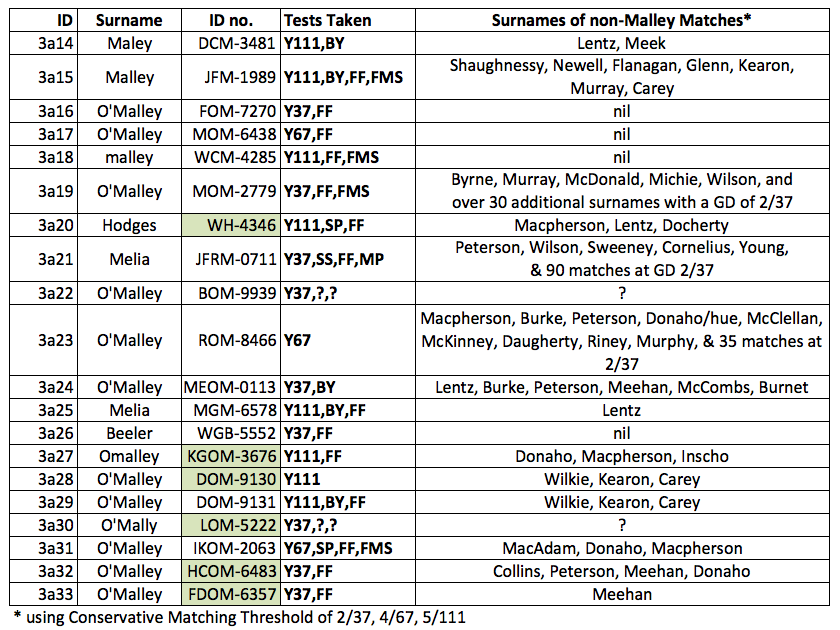
So that leaves us with the surnames of each member's STR-related matches. We can try to control for Chance Matches by using a Conservative Threshold (2/37, 4/67, 5/111) rather than the Usual Threshold (4/37, 7/67, 10/111). This gives us the list in the table below. Some group members have many matches with a GD of 2/37 (90 in once case) so it may be that this particular threshold is not conservative enough and a GD threshold of 1/37 would be more appropriate.

List of surnames of group members' STR-matches using Conservative Matching Threshold

This exercise generated a list of 32 unique surnames. At least 3 of them (Carey, Wilson, Inscho) do not sit on branches below DF105 and therefore are not related to the Group 3a O'Malley's for at least 1850 years. I used the surname distribution maps on Shane Wilson's website to explore where these names most commonly occurred.
  • Some have strong associations with the Mayo/Galway area: Burke, Burnet, Flanagan, Newell, Shaughnessy
  • Others with Donegal: Docherty, Meehan, Sweeney, Wilkie
  • And quite a few have a probable Scots-Irish origin: Glenn, MacAdam, Macpherson, McClellan, McDonald, McKinney, Wilson, Young

So no clear conclusions can be drawn about the origins of Group 3a based on the surnames of genetically-related matches.

So that leaves the third method (extensive pedigrees) as a means to establishing the origins of the group. And for that we will need to identify extensive pedigrees going back into the 1600s, before the major land grab that followed Cromwell's conquest of Ireland in the mid-1600s. We don't have any such extensive pedigrees at the moment but there are ways that we can target people with such pedigrees and ask them to test and join the project. And that will be the topic of a subsequent post.

Summary

So the conclusion so far regarding the origins of Group 3a is "probably Mayo", based mainly on the fact that 8 of the 20 members have stated Mayo as the probable or possible origin of their Most Distant Known Ancestor.


How old is the group?

There are several ways of assessing how long the group have been carrying their particular genetic signature:
  1. MDKA birth information
  2. TiP Report tool (using the group's maximum GD values)
  3. SNP dating
  4. Dave Vance's SAPP Tool

The MDKA information currently provided shows that the earliest pedigrees go back to 1756 and 1770, suggesting that the group may have carried their genetic signature since the late-1700s at least.

The TiP Report tool generates the following TMRCA estimates based on the largest GDs within the entire group (TMRCA, Time to Most Recent Common Ancestor). The midpoint estimate is the 50% level, and I have included 5% and 95% levels to give a better idea of how broad the range is around each midpoint estimate (note that 24 is the highest number of generations the calculator can go). The midpoint estimate is primarily around the 1440 timepoint, with a range of pre-1230 up to 1710. You can see from this how crude the calculation is.

TMRCA Estimates for the most distantly related members of Group 3a
(the top table gives the TMRCA in generations, and the
bottom table converts it to a crude year,
allowing 30 years per generation)

SNP dating (allowing 100 years per SNP) suggests that the branch BY35730 (which is almost exclusively O'Malley's - there is a single Donaho in there too) was formed at least 1250 years ago (if not much earlier). This is calculated as indicated below. Please bear in mind these estimates are very crude indeed.
  • BY35730 is a 7-SNP block (representing about 700 years)
  • the branch below that is a 3-SNP block (representing about 300 years) but for some reason The Big Tree does not show BY35759 in this block, but FTDNA's Big Y Block Tree does. 
  • the blue numbers below indicate the number of unique / "private" SNPs discovered for each of the 4 Big Y test-takers
    • the Most Recent Common Ancestor (MRCA) for the branch on the left can be calculated thus: (4+6+4) / 3 = 4.7 = 470 years ago (i.e. about 1500 AD)
    • the TMRCA for the left & right branch is about 535 years ago, calculated thus: 470 + 300 on the left, 300 on the right, average for the 2 branches is (770+300)/2 = 535 years ago. This equates to about 1400 AD and suggests that Group 3a have carried this DNA signature for at least the last 600 years or so.
    • the TMRCA for the next branch up (DF105) is about 535 + 700 = 1235 years ago, based on the data below, but when taking into account the data from all 456 branches below DF105, YFULL estimates that this branch is at least 1850 years old.

The position of Group 3a on the Tree of Mankind (from The Big Tree)
The blue numbers indicate the number of Unique / Private SNPs 

And lastly, the 'best fit" family tree generated by the SAPP Tool suggests that the common ancestor for the entire group was born about 1400 AD (but within a very broad range of 1000 to 1750). The accuracy of these estimates would be improved if everyone in Group 3a upgraded to 111 STR markers (i.e. Y-DNA-111) or the Big Y-700 (which covers up to 700 STR markers). More information on this Mutation History Tree is included in the footnotes. [4]

The Mutation History Tree for O'Malley Group 3a (generated by the SAPP Tool)
Black numbers refer to the ID numbers but without 3a in front of them.
Red numbers refer to the estimated date of each branching point.

Summary

So based on all the above data, the best guess is this group has been carrying their DNA signature for at least 600 years (1400 AD approximately). That leaves about 400 years unaccounted for, back to the foundation of surnames about 1000 AD. What happened during those 400 years is anybody's guess. Was the O'Malley surname of Group 3a associated with the same particular DNA back to the time that the surname was founded? or was there an SDS (Surname or DNA Switch) somewhere along the way, and the O'Malley surname was previously associated with a different DNA signature? We simply don't know at this stage. But we can calculate the probability that an SDS occurred, and that probability is 13-24%. [5] Which means the probability of no SDS is quite high (i.e. 76-87%).


Is there a link to an Irish Clan?

Which brings us to the last question: can we link Group 3a to Grace O'Malley? does the DNA signature of Group 3a represent the Y-DNA signature of Grace O'Malley's male forebears?

Well, although the TMRCA estimates for the group are tentative, they do nevertheless bring us back to the time of Grace O'Malley (1530-1603) and this is encouraging news. There are two possible ways in which we can establish a link to Grace.
  1. Firstly, if we can find extensive pedigrees that can be linked to Grace, then it may be possible to test living male descendants of her brother or uncle (or other male relatives). If they share the same Y-DNA signature as Group 3a, then this is very strong evidence that we have identified the Y-DNA signature of Grace's clan. 
  2. The second approach involves searching the ancient pedigree of Grace's O'Malley clan and identifying the associated surnames. If the Y-DNA signature of Group 3a is that of Grace O'Malley's clan, then there should be a higher incidence of the signature among the supposedly genealogically-related surnames. There are several sources that can be used to obtain the ancient pedigree [3] and a similar approach was taken to identify the Y-DNA signature of the Dal gCais (Doll Gosh) and it's most famous son Brian Boru. [6]
The strategy for this next stage of the project will be discussed in a separate post.


Conclusions & Next Steps

The predominant surname among Group 3a is O'Malley. The MDKA of many group members (8 of 20) goes back to Mayo. This group has carried its associated DNA signature since about 1400 AD.

All group members should join the M222 Haplogroup Project. Just click this link and sign in to your FTDNA account.

In addition, all group members should join the Ireland Y-DNA Project (click here to join).

The Admins in these projects may provide some additional insights and advice on further SNP testing. I am frequently in touch with these Admins about project-related matters.

All members should supply a birth location for their MDKA - see item 2 on this page for full instructions.

All members should supply pedigree information about their direct male line - full instructions are on the Post your Pedigree page.

More people should do the Big Y test - because so many Group 3 members have Chance Matches, it is the only way to ensure that you are accurately grouped. All people undertaking the Big Y test should upload their data to The Big Tree for some additional essential analyses (provided for free by Alex Williamson and his team).

Going forward, there will be a concerted effort to identify and test people with extensive pedigrees. We need more recruits for this purpose and project members are encouraged to find and engage such people. I am very happy to help with this as required.

Additional analysis will be undertaken to assess if surnames that are supposedly genealogically-related to Grace O'Malley's direct male line share the same Y-DNA signature as Group 3a. This will follow a similar approach to that successfully used to identify the Y-DNA signature of the Dal gCais & Brian Boru.

Maurice Gleeson
July 2019


Footnotes & Sources

[1] In genetic genealogy, Convergence occurs when two men have DNA signatures that are exactly or nearly identical, but that have evolved that way purely by chance. As a result, the two men will show up in each others' list of matches and will give the false impression that they may be closely related (e.g. within the last several hundred years) when in fact they are much more distantly related (e.g. within the last several thousand years). It is a "Chance Match". The problem is we cannot tell that Convergence has occurred simply by looking at the two men's STR results. It is hidden from our view. We cannot see it just by looking at the present-day STR data. And the danger is that if the two men think they are closely related, they may start chasing their common connection, thinking that they will find the answer via further documentary research, when in fact there is little hope of that at all. Their "close match" is a red herring. And their pursuit of the Common Ancestor is a wild goose chase.


[2] Surname Distribution Maps for Ireland can be found on several websites:
  • John Grenham's website (www.johngrenham.com) has maps based on Griffith's Valuation (from the mid-1800s). The first 5 searches are free and then you need to take out a subscription.
  • Shane Wilson's website also uses Griffith's Valuation (https://www.swilson.info/sdist.php). No subscription needed.
  • Barry Griffin's website has maps based on the 1901 & 1911 censuses, including maps identifying just the farmers (whose families are likely to have held the land for several generations at least).
  • I used to use the PublicProfiler websites (WorldNames & GBNames) but these no longer seem to be maintained.
  • I also used to use the forbears.co.uk but the new format provides less fine detail than previously.


[3] There are several Surname Dictionaries that provide Irish surname histories and the most useful are:
  • MacLysaght, Edward. Several books but unfortunately not available online:
The Surnames of Ireland. 1957 (sixth edition 1991)
Irish Families. Their Names, Arms and Origins. 1957 (fourth edition 1985)
More Irish Families. 1970 (first paperback edition 1996, incorporating Supplement to Irish Families, 1964)


[4] Because we have quite a few members in this particular group, we can build a Mutation History Tree (MHT) from the available pedigrees and the STR & SNP mutations (hence the name, Mutation History Tree). This can be done visually or by using Dave Vance's SAPP Programme. I've done this for my Gleeson Lineage II and you can see a video about it here (from the FTDNA Annual Conference in 2017).

In effect, the tree is using genealogical data back to the time of the MDKA and thereafter is using DNA mutations to define the connectedness between different branches. This generates a branching structure based on mutations and thus a "best fit" family tree for the entire group of 20 people. As more data becomes available, the "best fit" may adapt and change. So it merely represents the "group family tree" that is closest to what we currently can estimate given the available genealogical and DNA data. The optimal "best fit" would be achieved by all group members doing the Big Y-700 test - this would define all the SNP markers shared among the group members, as well as any mutations in their c.700 STR markers.

The advantage of the MHT is that it identifies specific sub-branches within the overall group and helps identify who is more closely related to whom. This in turn helps with genealogical enquiries and collaboration between group members.


[5] the risk of an SDS (Surname or DNA Switch) is calculated thus:
  • 400 years represents approximately 13.3 generations (allowing 30 years per generation)
  • The rate of SDS's is about 1-2% per generation (based on several published studies)
  • The probability of having no SDS's in 13.3 generations given a 1% SDS probability per generation is 0.99^13.3 = 0.8749 (87%). So the probability of having at least one SDS is 1 - 0.8749, that is 13%.
  • The probability of having no SDS's in 22 generations given a 2% SDS probability per generation is 0.98^13.3 = 0.7644 (76%). So the probability of having at least one SDS is 1 - 0.7644, that is 24%.
  • So there is a 13% to 24% chance that there was a switch in the surname or the DNA for Group 3a during the 400 year period between the foundation of surnames (1000 AD) and the MRCA for the group (born about 1400 AD approximately).


[6] Dennis M Wright, 2009. A Set of Distinctive Marker Values defines a Y-STR Signature for Gaelic Dalcassian families. Journal of Genetic Genealogy, 5(1):1-7. Available at http://www.jogg.info/pages/51/files/Wright.pdf


Finding Grace - project update 2025

We started the Finding Grace project back in 2022 and quickly identified 13 people whose genealogies recorded their likely descent from D...